Behind the Scenes of Steelers Draft Day Chess Match
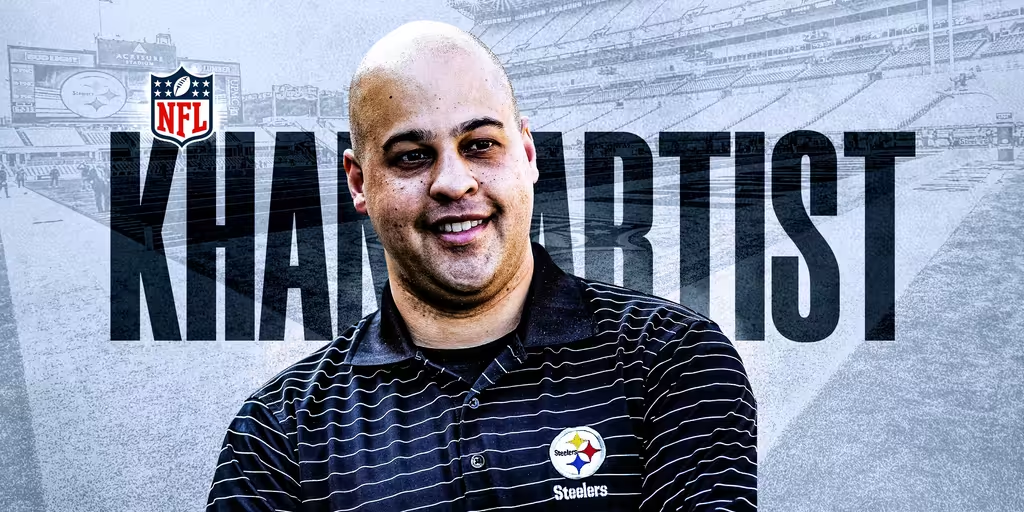
- On the morning of the 2029 NFL Draft, Omar Khan sat in a war room that looked nothing like the chaos playing out on television.
There were no panicked phone calls. No last-minute scrambles. No whiteboard sessions debating whether to reach for a quarterback the organization had privately decided weeks ago it did not want. The Pittsburgh Steelers general manager had spent months constructing a draft-day framework so layered and contingency-driven that what appeared to the outside world as a series of spontaneous, occasionally baffling decisions was, in reality, a plan executing almost exactly as designed.
Almost.
This is the story of how Pittsburgh's 2029 NFL Draft actually unfolded; told through the conversations, decisions, and near-misses that never made it onto the ESPN broadcast.
The Quarterback Myth
Let's start with the assumption that drove most of the pre-draft coverage surrounding the Steelers: that Pittsburgh desperately needed to use one of its two top-ten picks on a quarterback.
It was never happening.
Sources with direct knowledge of Pittsburgh's draft board confirmed to The Athletic that the Steelers had no intention of selecting either Washington's Gavin Johnson or Georgia Tech's Clayton Owens with a first-round pick. The scouting department's internal evaluation of both players aligned closely with the most skeptical public assessments—neither graded as a franchise-caliber quarterback, and Khan had no interest in spending premium capital on a player who might, at best, be a competent placeholder.
"Pittsburgh was never sold on either of them," one source told The Athletic. "The whole narrative about them desperately needing a quarterback in the first round assumed they thought those guys were the answer. They didn't."
The quarterback Khan actually wanted was BYU's Andrew Schafer—the under-the-radar prospect with the live arm and raw upside that scouts had been quietly buzzing about for months. But Schafer was a Day 3 projection, and Pittsburgh's preferred path to solving the quarterback question was never the draft board at all. It was the trade market.
Khan had identified two targets. The first was Leonard Lawry, Minnesota's second-year quarterback whose pre-draft slide out of the first round— driven by character concerns that Pittsburgh's research had largely debunked—made him a compelling acquisition target at a fraction of the cost of a top pick. The second was Miami Dolphins quarterback Rayshaun Davis, the rookie sensation whose 2028 campaign had turned heads across the league. The Dolphins, however, were deeply reluctant to move Davis given Tua Tagovailoa's lengthy injury history and their understandable desire to keep a capable, proven backup in the building. That door never fully opened.
With Davis unavailable, Lawry became the primary focus. Pittsburgh opened quiet dialogue with Minnesota well before draft weekend, laying the groundwork for an acquisition that would ultimately define their entire approach to the three-day event.
The Phone Call That Changed Everything
Pittsburgh entered draft night holding the second overall pick—acquired from the Seattle Seahawks in last year's draft—and had exactly one player they would have selected with it: Oregon defensive tackle Zach Jenkins, the consensus top prospect in the class, in the event the Tennessee Titans somehow passed on him at first overall.
They didn't. The Titans took Jenkins without hesitation, and Pittsburgh's interest in the second pick effectively evaporated the moment Goodell walked to the podium.
What followed was a negotiation on two fronts simultaneously.
The Las Vegas Raiders had been in discussions with Pittsburgh for weeks about the second pick, offering their own 17th overall selection, first-round picks in 2030 and 2031, and a fourth-round pick in the current draft. It was a substantial offer—three first-round picks in exchange for moving up fifteen spots—and Khan had the framework of an agreement in place heading into draft night.
Then Baltimore called.
The Ravens, locked onto USF defensive end Steven Gardiner, came to Khan with an offer that was structurally different from Las Vegas' in one critical way: immediate ammunition. Baltimore's package—the 12th overall pick, four additional selections in the current draft, and a 2030 first rounder—gave Pittsburgh five more picks to work with in the next 48 hours rather than future capital spread across two years.
The distinction mattered enormously, because Khan already knew what he was going to do with those picks.
"Pittsburgh was already deep in talks with Minnesota about Lawry," one source explained. "They needed current picks to make that deal work. Baltimore gave them that. The Raiders deal was better on paper in terms of long-term value. But the Ravens deal fit the actual plan."
The decision took less time than the broadcast made it appear. Khan took Baltimore's offer, the Ravens raced to the podium to grab Gardiner, and the Steelers settled in for a night of chess.
The Target at Ten
With their own tenth overall pick, Pittsburgh had clarity long before draft night arrived.
Iowa State offensive tackle Steven Seri had been the target regardless of what else happened. Sources say that even in the scenario where Pittsburgh made no trades at all and held both the second and tenth overall picks they would have taken Texas' Bobby Roth or Arkansas' Bernie Cheeks, then selected Seri if he was available.
Seri's appeal was straightforward and very Pittsburgh—a physically dominant, technically sound tackle with the temperament and work ethic the organization prizes above almost everything else. The fit alongside Fautanu and the long-term offensive line planning made him an easy call.
The pick took forty-five seconds to submit.
The Near-Miss at Twelve
Pittsburgh's plan at twelfth overall was considerably less clean.
The internal target was Wisconsin defensive tackle Brad MacDonald—a prospect the Steelers had assigned a first-round grade to and fully expected to be available when Kansas City picked one spot ahead of them at eleventh. The Chiefs took MacDonald, and Khan found himself in a position he had not fully anticipated: needing to find an alternative with the clock running.
The fallback was Cole Rogan, the Miami defensive end who represented Pittsburgh's only other first-round grade among defensive linemen. The problem was that Khan had already taken Detroit's call about trading back—an offer that would net Pittsburgh three additional picks in exchange for moving from twelfth all the way back to 30. Rogan was good enough, in the Steelers estimation, to justify the twelfth pick, but was he good enough to justify passing on three picks?
Khan made the calculation quickly. He believed Rogan would be available at thirty. He took Detroit's offer, traded back, and spent the remainder of the first round hoping he was right.
He was. Rogan was still on the board at thirty.
"It was a gamble," one source acknowledged. "Omar knew it was a gamble. But he had a read on how the board was falling and he trusted it."
The Lawry Deal: What Actually Happened
The public narrative around the Leonard Lawry trade suggested Pittsburgh waited until Steven Wimbley was off the board before pulling the trigger, a reading of the situation that implied the Steelers were monitoring the second round's opening pick before committing to a deal.
The reality was nearly the opposite.
Pittsburgh had a deal with Minnesota in place before Day 2 began. The structure of that deal, however, had a variable built into it—one tied directly to whether Wimbley was available when the Steelers picked tenth-overall in the second round.
Minnesota, sitting on a Lawry they no longer needed with J.J. McCarthy locked up on a four-year extension, was willing to move the young quarterback. But the price depended entirely on their ability to replace him. If Wimbley was still on the board when Pittsburgh's tenth pick arrived, the Vikings could acquire him as a ready-made McCarthy insurance policy—and the Lawry deal would have cost Pittsburgh a second-round pick, a 2030 fourth, and safety Mac Kopp. A palatable price.
The moment Tennessee called Wimbley's name to open the second round, Minnesota's calculus shifted entirely. Without the security blanket of a replacement quarterback waiting at tenth overall, the Vikings pushed for more compensation before parting with Lawry. The asking price increased by one third-round pick—a selection Minnesota used to draft Fresno State quarterback Ashton Peerman later in the weekend.
'Minnesota needed to know they weren't left exposed at the position,' one source explained. 'Once Wimbley was gone, they had no fallback. Pittsburgh paid the premium for that.'
Whether the extra third-round pick was worth the premium will be a storyline worth revisiting in a few years.
The Cunningham Collapse
If there is a single moment that best illustrates the unpredictable nature of even the most carefully constructed draft plans, it is the Al Cunningham sequence, a chain of events that rippled through Pittsburgh's Day 2 and Day 3 selections in ways that were still being felt in the seventh round.
Pittsburgh had assigned Cunningham, a wide receiver prospect, a second-round grade and fully intended to select him with the 30th overall pick of the second round—a selection acquired from Detroit. Khan made the calculated decision to use that pick on Arkansas safety Sal Stanley instead, banking on Cunningham being available three picks later when Pittsburgh was back on the clock using Seattle's third-round selection.
Philadelphia took Cunningham at 31st.
The domino effect was immediate. Without their primary target, Pittsburgh scrambled and selected Virginia Tech's Zach DeVine—a pick that analysts openly described as a reach and that the Steelers' own war room acknowledged was not the scenario they had planned for.
The scramble didn't end there. With Devine now on the board and linebacker addressed in an unsatisfying way, Pittsburgh's approach to the fourth round shifted. Wide receiver had been a secondary need, and with Pittsburgh native Jared Hutson of the University of Pittsburgh available as the fastest receiver remaining on the board, Khan pulled the trigger—a pick driven as much by the Cunningham miss as by Hutson's own draft profile.
"That one pick by Philadelphia changed three selections for Pittsburgh," one source said. "The Devine pick, the Brooks pick, the Hutson pick—all of them trace back to Cunningham being gone three spots early."
The Flores Intervention
By the time the seventh round arrived, Pittsburgh's linebacker room had already been addressed—twice, some would argue awkwardly—through the selections of Devine and Hugh Brooks. The case for drafting a third linebacker in the same draft, particularly one coming off a significant knee injury, was not immediately obvious to everyone in the room.
It was obvious to Brian Flores.
The Steelers' defensive coordinator had been tracking Penn State's Landon Mackey throughout the pre-draft process and had spent considerable time with Pittsburgh's medical staff reviewing the knee injury that caused Mackey to fall from first-round consideration entirely. When the seventh round arrived and Mackey was still available, Flores made his case directly and without equivocation.
"Brian told them the doctors cleared him one hundred percent," one source said. "That was his entire argument. You have a former All-American middle linebacker with ideal size, ideal athleticism, and ideal football character sitting right there in the seventh round. The knee is fine. Take him."
Khan took him.
Whether Flores' instinct proves correct will depend on a knee that has not yet been tested at the NFL level. But the profile—6'4", 228 pounds, All-American pedigree, sideline-to-sideline range—is the kind of player that seventh-round picks almost never are. If Mackey is healthy, Pittsburgh may have just taken the most valuable player of their entire draft with their final selection.
The Verdict
Three days. Thirteen picks. A quarterback acquired through the trade market rather than the draft board. A potential franchise tackle in Seri. And a seventh-round linebacker who, if the medical clearance holds, might be the steal of the entire class.
Khan's draft-day approach was unconventional enough to generate genuine anxiety among a fanbase still raw from the Richardson saga. The trade with Baltimore, in particular, required a certain faith in the process that not everyone was willing to extend in the moment.
By Sunday evening, most of them had come around.
"He's the Khan Artist, people," one fan had posted on X during the height of Thursday night's chaos. "Have faith."
Three days later, it was hard to argue with the sentiment.

 that's a good one - I didn't think of that