

Spring Practice Notes: Offense
Here's what we learned so far this spring
Mailbag — Preseason
 By Diego Alfaro
Published: April 11th, 2026
An explosive group of wide receivers came as advertised, but the depth and talents of the ground attack were a pleasant surprise to complement the passing game. Here’s what we learned about these aspects and more regarding the ASU offense during spring.
Quarterback
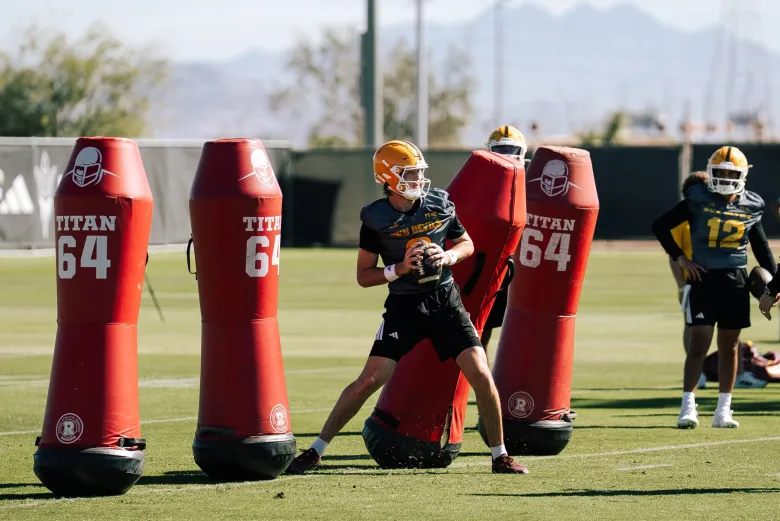
ASU’s offensive coordinator, Marcus Arroyo, said that the race for the starting signal caller is “Nowhere near arrival.” In our opinion, that was anything but a hyperbolic statement. Perhaps some are disappointed that a clear starter has not been established at the end of spring, but when a room of brand new quarterbacks, not arriving at a definitive conclusion in this much-anticipated position race, was probably a more realistic scenario to begin with.
It would hardly be a leap to state that Kentucky transfer Cutter Boley leads this race. If he had started spring on a much stronger note than he did, matching the relatively formidable finish he had, then perhaps Arroyo’s statement would take on a different tone. Yet, there’s no denying that Boley looked more comfortable and, more importantly, committed fewer turnovers as spring progressed.
I know that the ASU fans who were apprehensive about his signing pointed to his 12 interceptions last year, and those fears didn’t vanish with his rocky spring start. However, I attribute those multiple interceptions he threw in the first week of spring to the growing pains of a young signal caller in a brand-new school and a brand-new offense. In the second half of spring, he certainly turned the corner and was very effective utilizing his elite group of wideouts. He gets the ball out quickly, exercises good decision-making, and doesn’t force anything. Granted, he looks more impressive in short and medium routes than the deeper ones, and with this arsenal of weapons, you would definitely want him to utilize that facet of the offense. With the correct offensive approach, utilizing his strengths and hiding his deficiencies, there’s no reason to believe that he can’t thrive as a starter and help this offense get back to its explosive ways of 2024.
Michigan transfer Mikey Keene followed, more or less, Boley’s path, improving his performance every week. I’m a little surprised that his vast experience didn’t help him challenge Boley more than he has or create the distance required to nail down the No. 2 QB spot. Being a deft long-ball thrower is also a shortcoming for Keene, and a lack of athleticism can only make the uphill battle harder. But again, he did finish spring with some momentum that could produce a strong fall camp and conceivably see him in a different light.
True freshman Jake Fette is undoubtedly justifying the high accolades he arrived with. Enough to challenge Boley as a starter? I don’t believe so, but starting the season as the backup to Boley is not out of the question. Fette is a more mobile QB who uses it to his advantage to evade rushers, whether throwing the ball or gaining ground with his feet. His poise in the pocket is impressive, especially for such a young player. On the other hand, there are obviously some instances where he does look like a true freshman. So, keeping those mistakes to a minimum will determine how high he will place himself on the depth chart.
Cam Dyer, the only returning quarterback in the room, definitely has an uphill battle to pass Fette on the depth chart and will need to come out of the gates blazing in August.
Running Back
On paper it’s an embarrassment of riches with so many players who shined during spring at different times. As I always joke, the “dream” of the running back by committee we seemingly hear every preseason in the last several years just may come to fruition. Furthermore, the staff’s desire to put more emphasis on the running game with two-back sets is a theory that may be effective in this room, since the spring returns of the ground game have been promising.
Kyson Brown, the most veteran returning player and one whom some expect to be the starter, generally showed well. At 6-foot-1, 205 lbs., you would expect him to be more of a bruiser who doesn’t go down easily, let alone be the go-to guy in short-yardage situations and have that complement his athleticism better. If he were a more well-rounded player, he would likely separate himself from the pack.
Delaware State transfer Marquis Gillis was someone I expected pre-spring to be in contention for a starting role, or at the very least in a very high-depth-chart niche, but his recovery from injury led to a slow spring start. Nonetheless, when he was full-go, we got to see a back very similar to Kyson Brown in frame, but also one who was hard to bring down and showed elusiveness in the open field. I’m highly intrigued to see him healthy from the get-go in fall camp and see where that performance can take him (my guess, very high).
I expected Jason Brown to come in with a lot of confidence, flowing from his career game in the Sun Bowl. The biggest question for him is consistency, which is why he found himself way down the depth chart in 2025. The overall competition he faces this year is greater, but with more experience on his side now, and with great motivation to prove that his entire body of work in 2025 wasn’t representative of his skills, I could see him higher in the rotation.
True freshman Cardae Mack already flashed in bowl prep practices. His resemblance to former ASU RB Demario Richard, both in his build and running abilities, is truly uncanny. His ability to read the gaps and maintain proper body control to navigate defenders is atypical for a player getting his first taste of power-conference football. Coaches already told me that he’s not redshirting this year, and it’s easy to see why.
David Avit, the Villanova transfer, is probably the biggest surprise among the newcomers because while he was pegged to be the solution in short-yardage situations, I’ve been really impressed with how good a receiver he is out of the backfield. At 6-foot-0, 225 lbs., you don’t expect a running back to be as agile as he is, so he may not be the one-trick pony, so to speak, and get the ball also when it’s more than a couple of yards to go for a first down.
Demarius Man Man Robinson flashes enough to remind all of us that he definitely cannot be counted out, even in a deep, talented position room. But overall, he hasn’t been as steady as all the running backs I mentioned before him.
Grayson Rigdon, even in such a crowded unit, has been able to stand out on more than a couple of occasions. How much he can improve his apparent lower standing in the rotation remains to be seen. Undoubtedly, he’s somebody who can push his teammates.
Wide receiver
I said it before, and I’ll say it again if anyone thinks that the wide receiver group is going to take a huge step back post-Jordyn Tyson, you are greatly mistaken. No, I don’t think there’s any particular player in this group that can put up gaudy numbers and huge highlights every Saturday, but the overall talent of this unit is night and day compared to last year. Impossible to overstate how well ASU did in the transfer portal when it comes to this specific position, as all three transfers are fully expected to be starters, and it’s hardly a case of being the lesser of two evils.
Omarion Miller naturally draws comparisons to Tyson because he is also a transfer from Colorado. As mentioned, maybe not producing the frequency in the volume of highlight plays, but definitely proves why he should be the number one option in the passing game. He’s coming in as a very accomplished wide receiver, but under the guidance of Hines Ward, he can surely take his game to the next level. The bottom line is that we expected him to shine in the spring and show why he was the number two wide receiver in the transfer portal, and so far, he’s done anything but disappoint.
I’m still shaking my head in a very good way, trying to figure out how Arizona State, a school where its coaches have no problem admitting that they’re not the biggest NIL check giver if you will, was able to add a wide receiver of the caliber of Boston College transfer Reed Harris. Why so many schools seemingly passed on him or did not recruit him in earnest is beyond me. To say he is an absolute freak at 6-foot-5 still doesn’t do him justice because the way he moves is borderline jaw-dropping, and he was a reliable highlight nearly every practice. Sure, you expect him to be a very effective weapon in fade routes and in tight spaces, but he can beat a lot of defensive backs in a foot race down the field. I know “matchup nightmare” is one of those clichés that gets thrown around way too often, but Harris fully embodies that description.
And it’s probably not fair for Raiden Vines-Bright not to be talked about as much as the other two transfers, but trust me, he has been an unbelievable get for the Sun Devils, and I know Washington Insiders were not too happy to see him leave the Huskies. There are certainly solid players at the slot wide receiver position for ASU, but this newcomer is the one expected to be the starter at this role. He’s a really good technician, excellent blocker, just like the other two transfers, and even though this is an offense that sometimes does not involve the slot receiver all that often, in my humble opinion, that has to change when you have his level of talent.
When I look at the reserves, Jalen Moss, who went through hell and back last year with injuries and illness, is another player like Jason Brown, who was able to build on the foundation of a very strong performance in the Sun Bowl and carry that momentum into the spring. Sure, he’s unlucky that Vines-Bright has played exceptionally well, but it’s good to see both players pushing each other as much as they are.
Jaren Hamilton has been sort of quiet in the spring, but still shows what a formidable downfield threat he can be. True freshman Uriah Neloms has been one of the most pleasant surprises of the spring, and if he can keep it up, you definitely have to consider him as a rotation player. Cory Butler has had more than a few good moments during spring and is another good option for the slot. Converted quarterback back Michael Butter Tollefson has done well in his new role. Due to injuries, Derek Esubio and Plas Johnson will have to wait for fall camp to try and carve a spot in the rotation, and another injured player, Harry Hassmann, who’s recovering from ACL surgery, is going to have to wait longer than that to be fully cleared.
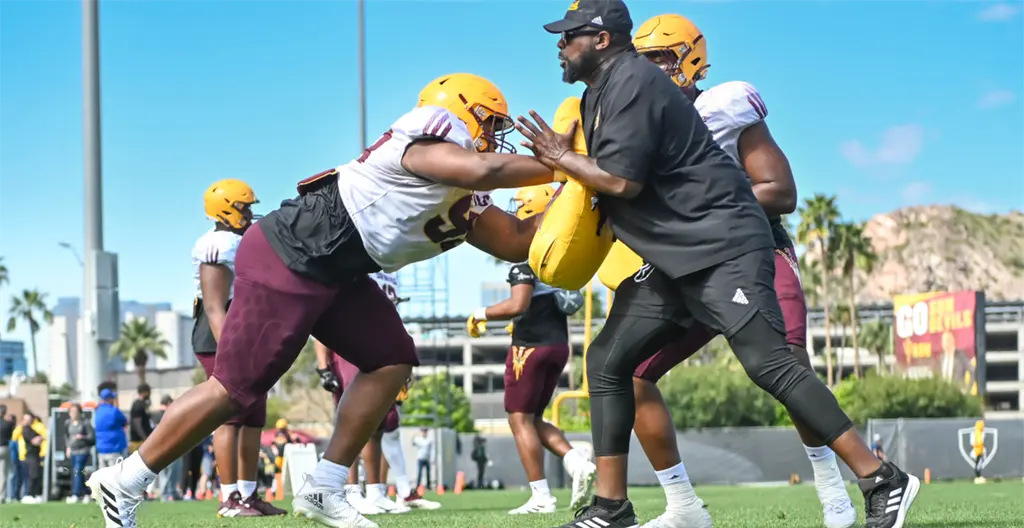
Offensive line
Georgia Tech center Tana Alo-Tupuola has unquestionably one of the most important transfers this year and brings a slot of stability to the front five, an aspect we all know was sorely missing in 2025. No snapping issues and came as expected as a deft blocker from a heavy-run Yellow Jackets offense. At the risk of sounding hyperbolic, he is an absolute blessing for this offense. Luckily, his MCL sprain suffered late in spring should not prevent him from being fully healthy for fall camp. Makua Pule is all but a lock to be Alo-Tupuola’s backup.
Another transfer portal player who impressed me is right tackle Luke Baklenko. Not suggesting he’s gonna make us forget about Max Iheanachor, who is expected to hear his name called in the first round this week, but he figures to be a good addition here as he battles with junior college transfer Leni Lapuaho for starter duties. At left tackle, I like what I’m seeing from Champ Westbrooks, who I think can hold off Jalen Klemm for the starting role. Now, once junior college transfer Jarmaine Mitchell begins fall camp healthy, the former Georgia commit can realistically make things very interesting in that position battle.
Maki Stewart, who played a lot and rightfully so as a freshman last season, is all but cemented as a starter at one of the guard positions. As we know, he played exclusively on the left side, but as Wade Helton and Rob Lapuaho battle between themselves, we could see Stewart move to the right side as one of those players shifts to the left side.
Tight end
The high level of running-game performance we’ve seen for a good deal of spring is naturally an aspect that is a credit not only to the play of the offensive line but also to the tight end. Aj Ia made significant strides in that department, but his calling card is still being a reliable target in the passing game.
Khamari Anderson had a very good spring and exemplified the good job that Boley does in the short and medium routes, which is why I expect Anderson to break out this year and put up numbers that could be Chamon Metayer-like. Alas, a huge caveat is how quickly and effectively he can recover from an ankle injury, which Kenny Dillingham hinted would limit him for some of fall camp, in theory, not having him fully cleared before the season opener.
This is why Anthony Miller, the Tulane transfer and a well-rounded tight end, will be asked to serve as the stopgap in Anderson’s absence. I think he can carry out that assignment well.
Credit Original Article